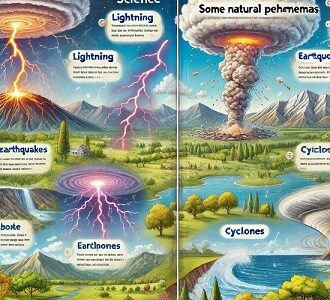
Class 8 Science Some Natural Phenomena
Explore Class 8 Science Some Natural Phenomena: Learn about lightning,earthquakes, and safety measures .
Q: What causes lightning to occur?
A: Lightning occurs due to accumulation of charges in clouds. Positive charges collect near upper edges and negative charges near lower edges of clouds. When the magnitude becomes very large, the charges meet, producing streaks of bright light and sound.
Q: What was Benjamin Franklin’s contribution to understanding lightning?
A: In 1752, Benjamin Franklin showed that lightning and the spark from clothes are essentially the same phenomena, demonstrating that lightning is an electrical phenomenon.
Q: What are the two types of charges, and how do they interact?
A: There are positive and negative charges. Like charges repel each other (positive-positive or negative-negative), while unlike charges attract each other (positive-negative).
Q: What is an electroscope used for?
A: An electroscope is a device used to detect whether an object is carrying an electrical charge or not. It typically uses aluminum foil strips that repel each other when charged.
Q: What is earthing?
A: Earthing is the process of transferring electrical charge from a charged object to the earth. It is provided in buildings to protect people from electrical shocks due to current leakage.
Q: Why should you avoid using an umbrella during a thunderstorm?
A: Using an umbrella during a thunderstorm is dangerous because it can attract lightning due to its height and metallic components, increasing the risk of getting struck.
Q: What is a lightning conductor?
A: A lightning conductor is a metallic rod installed on buildings that’s taller than the building itself, with one end in the air and the other buried in the ground. It provides an easy route for lightning to transfer charge to the ground.
Q: What causes earthquakes?
A: Earthquakes are caused by disturbances deep inside the earth’s crust, usually due to movement of tectonic plates when they brush past or collide with each other.
Q: What is the Richter scale?
A: The Richter scale is a scale used to measure the destructive power of an earthquake. Really destructive earthquakes have magnitudes higher than 7.
Q: What is a seismograph?
A: A seismograph is an instrument used to record seismic waves during an earthquake. It consists of a vibrating rod or pendulum with an attached pen that records the waves on moving paper.
Q: Name three high-risk earthquake zones in India.
A: Kashmir, Western and Central Himalayas, and the whole of North-East are among the high-risk earthquake zones in India.
Q: What should you do if you’re indoors during an earthquake?
A: Take shelter under a table and stay there until the shaking stops, staying away from tall and heavy objects that may fall.
Q: What are fault zones?
A: Fault zones are the boundaries of earth’s plates which are weak zones where earthquakes are more likely to occur. They are also known as seismic zones.
Q: How do charged objects become charged through rubbing?
A: When objects are rubbed together, electrical charges can transfer from one object to another, leaving one object positively charged and the other negatively charged.
Q: What does an increase of 2 in magnitude on the Richter scale mean?
A: An increase of 2 in magnitude means 1000 times more destructive energy, not just twice as much.
Q: What type of buildings are recommended in highly seismic areas?
A: In highly seismic areas, buildings made of mud or timber are better than heavy construction materials, and roofs should be kept as light as possible.
Q: What causes the separation of charges in clouds during a thunderstorm?
A: During thunderstorms, vigorous movements of air currents upward and water droplets downward cause separation of charges, though the exact process is not yet completely understood.
Q: Why should you stay inside a car during a thunderstorm?
A: Cars provide safety during thunderstorms because they act as a protective cage, with the metal body directing lightning around the occupants rather than through them.
Q: What should you do with electrical appliances during a thunderstorm?
A: Electrical appliances like computers and TVs should be unplugged, though electrical lights can remain on as they don’t cause harm.
Q: What are seismic waves?
A: Seismic waves are waves produced by tremors on the earth’s surface during an earthquake, which can be recorded by a seismograph.
Q: What precautions should be taken while constructing buildings in seismic zones?
A: Buildings should be designed to withstand major tremors, have simple structures, fixed cupboards and shelves, and proper fire fighting equipment.
Q: What causes static electricity in clothes?
A: Static electricity in clothes is caused by friction between different materials, particularly when taking off woolen or polyester clothes, which can result in charge accumulation.
Q: Why should you avoid bathing during a thunderstorm?
A: Bathing should be avoided during thunderstorms because water is a good conductor of electricity, and running water can carry electrical charge if lightning strikes nearby.
Q: What are the two destructive natural phenomena discussed in the chapter?
A: Lightning and earthquakes.
Q: What did ancient Greeks discover about amber around 600 B.C.?
A: They discovered that when amber (a kind of resin) was rubbed with fur, it attracted light objects such as hair.
Q: What happens when two charged balloons are brought near each other?
A: They repel each other because they have the same kind of charge.
Q: What happens when a charged balloon is brought near a charged refill?
A: They attract each other because they have different kinds of charges.
Q: What are static charges?
A: Electrical charges generated by rubbing that do not move by themselves are called static charges.
Q: What is an electroscope and how does it work?
A: An electroscope is a device used to detect whether an object is charged. It consists of aluminum foil strips that repel each other when charged with the same type of charge.
Q: What is earthing?
A: Earthing is the process of transferring charge from a charged object to the earth through a conductor.
Q: How are charges separated in clouds during a thunderstorm?
A: During thunderstorms, air currents move upward while water droplets move downward. These movements cause separation of charges, with positive charges collecting near upper edges and negative charges near lower edges of clouds.
Q: What causes lightning?
A: Lightning occurs when the magnitude of accumulated charges becomes very large and negative and positive charges meet, producing streaks of bright light and sound.
Q: What are three safety measures to be taken during lightning when outside?
A:
Stay away from tall trees
Do not lie on the ground
Squat low on the ground with hands on knees and head between hands
Q: What precautions should be taken inside the house during a thunderstorm?
A:
Avoid contact with telephone cords, electrical wires, and metal pipes
Avoid bathing
Unplug electrical appliances like computers and TVs
Q: What is a lightning conductor?
A: It’s a metallic rod taller than the building, installed with one end in the air and the other buried in the ground, providing an easy route for charge transfer during lightning.
Q: What causes earthquakes?
A: Earthquakes are caused by disturbances deep inside the earth’s crust, usually due to movement of earth’s plates.
Q: What are earth’s plates?
A: The outermost layer of earth (crust) is fragmented, and each fragment is called a plate. These plates are in continual motion.
Q: What are seismic or fault zones?
A: These are weak zones at the boundaries of plates where earthquakes are more likely to occur.
Q: Name three areas in India that fall in the earthquake danger zone.
A: Kashmir, Western and Central Himalayas, and the whole of North-East.
Q: What is the Richter scale used for?
A: The Richter scale is used to express the power (magnitude) of an earthquake.
Q: What magnitude on the Richter scale indicates a really destructive earthquake?
A: Earthquakes with magnitudes higher than 7 on the Richter scale are really destructive.
Q: What building materials are recommended in highly seismic areas?
A: The use of mud or timber is better than heavy construction materials, and roofs should be kept as light as possible.
Q: What should you do if you are in bed during an earthquake?
A: Stay in bed and protect your head with a pillow.
Q: What should you do if you are in a car during an earthquake?
A: Stay in the car and ask the driver to drive slowly to a clear spot. Don’t come out till the tremors stop.