Last updated on August 30th, 2023 at 10:29 pm
Human Digestive System Question Answers
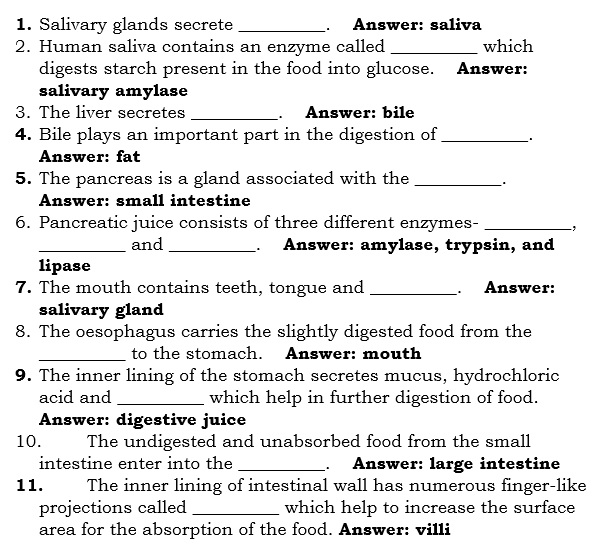
Fill in the blanks
Answer the following questions
Q: What is one healthy eating habit that should not be skipped?
Never skip breakfast as it provides more energy to do work.
Q: What is the importance of eating a balanced diet?
Eating a balanced diet is important, as it helps maintain good health.
Q: What types of foods should one consume to keep their digestive system healthy?
Consuming fresh fruits and vegetables can keep the digestive system healthy.
Q: What changes in lifestyle can help avoid the problem of indigestion?
Eating many small meals instead of two or three meals, avoiding snacks at late night, avoiding lying down immediately after eating food, avoiding spicy food and coffee, and avoiding smoking and tobacco.
Q: Why should lying down immediately after eating be avoided?
Lying down immediately after eating should be avoided to prevent indigestion.
Q: What type of food should be avoided to prevent indigestion?
Spicy food and coffee should be avoided to prevent indigestion.
Q: What is the function of salivary glands in digestion?
Salivary glands secrete saliva which contains an enzyme called salivary amylase that helps digest starch present in food into glucose.
Q: What is the function of bile in digestion and where is it stored?
Bile, secreted by the liver, plays an important role in the digestion of fat. It is stored in the gallbladder.
Q: What is the role of the pancreas in digestion and what enzymes does it secrete?
The pancreas secretes pancreatic juice, which consists of three different enzymes: amylase, trypsin, and lipase. Amylase is a starch digestive enzyme, trypsin is a protein digestive enzyme, and lipase is a fat digestive enzyme.
Q: What are the components of the mouth that aid in digestion?
The mouth contains teeth, tongue, and salivary glands which secrete saliva, a digestive juice that partially digests the starch present in food.
Q: What is the function of the oesophagus in digestion?
The oesophagus is a tube that connects the mouth to the stomach and carries partially digested food from the mouth to the stomach using peristalsis.
Q: What are the secretions of the stomach that aid in digestion?
The inner lining of the stomach secretes mucus, hydrochloric acid, and digestive juice to aid in the further digestion of food.
Q: Where does the complete digestion of food take place in the human body?
The complete digestion of food takes place in the small intestine, which is a very long tube about 7.5 meters long.
Q: What is the role of the villi in the large intestine?
The inner lining of the intestinal wall in the large intestine has numerous finger-like projections called villi, which help to increase the surface area for the absorption of food. However, the large intestine primarily absorbs water and electrolytes and forms solid waste products.
Q: What is bloating and what causes it?
Bloating is a swollen state caused by retention of fluid or gas.
Q: What is defecation?
Defecation is the act or process of discharging undigested or waste material from a cell or organism, specifically referring to the elimination of feces from the body.
Q: What is assimilation in the context of digestion?
Assimilation is the process of absorption of vitamins, minerals and other chemicals from food within the gastrointestinal tract.
Q: Which enzymes act upon food in the ileum of the small intestine?
Enzymes such as erepsin, maltose, sucrose, and lactase act upon food in the ileum of the small intestine.
Q: What is the function of the caecum in the digestive system?
The caecum receives the contents of the ileum and continues the absorption of water and salt.
Q: What are villi and what is their function in the small intestine?
Villi are tiny finger-like structures that line the inner surface of the small intestine, and their function is to aid in the rapid absorption of food.
Q: What is the function of bile and where is it secreted and stored in the body?
Bile is a green-yellow colored fluid that aids in the digestion of fat by converting it into tiny droplets for easier breakdown. It is secreted by the liver and stored in the gallbladder.
Q: What is peristalsis and where does it occur in the digestive system?
Peristalsis is the process by which food is moved forward in the food pipe as well as in the entire alimentary canal.
Q: Name the parts of the human digestive system.
The parts of the human digestive system include the mouth, esophagus, stomach, small intestine, and large intestine.
Q: What is the function of the tongue in the mouth?
The tongue helps in mixing saliva with food and softening it.
Q: What are the substances present in gastric juice?
Gastric juice contains three substances: hydrochloric acid, the enzyme pepsin, and mucus.
Q: What is the function of villi in the small intestine and what effect do they have on the surface area of the inner walls?
Villi aid in the rapid absorption of food and increase the surface area of the inner walls of the small intestine.
Q: What is the act of expelling feces from the body called?
The act of expelling feces from the body is called egestion or defecation.